
Molecular Hydrogen in an Oxygen Chamber: What Does 0.4–0.5% H₂ Actually Mean?
Oxygen Clinic publishes hydrogen as one part of its controlled chamber atmosphere. That does not make the session equivalent to experimental medical hydrogen inhalation.
Here is what H₂ is, how concentration and pressure affect exposure, what the closest published chamber study found, and why the current evidence still does not support broad treatment claims.
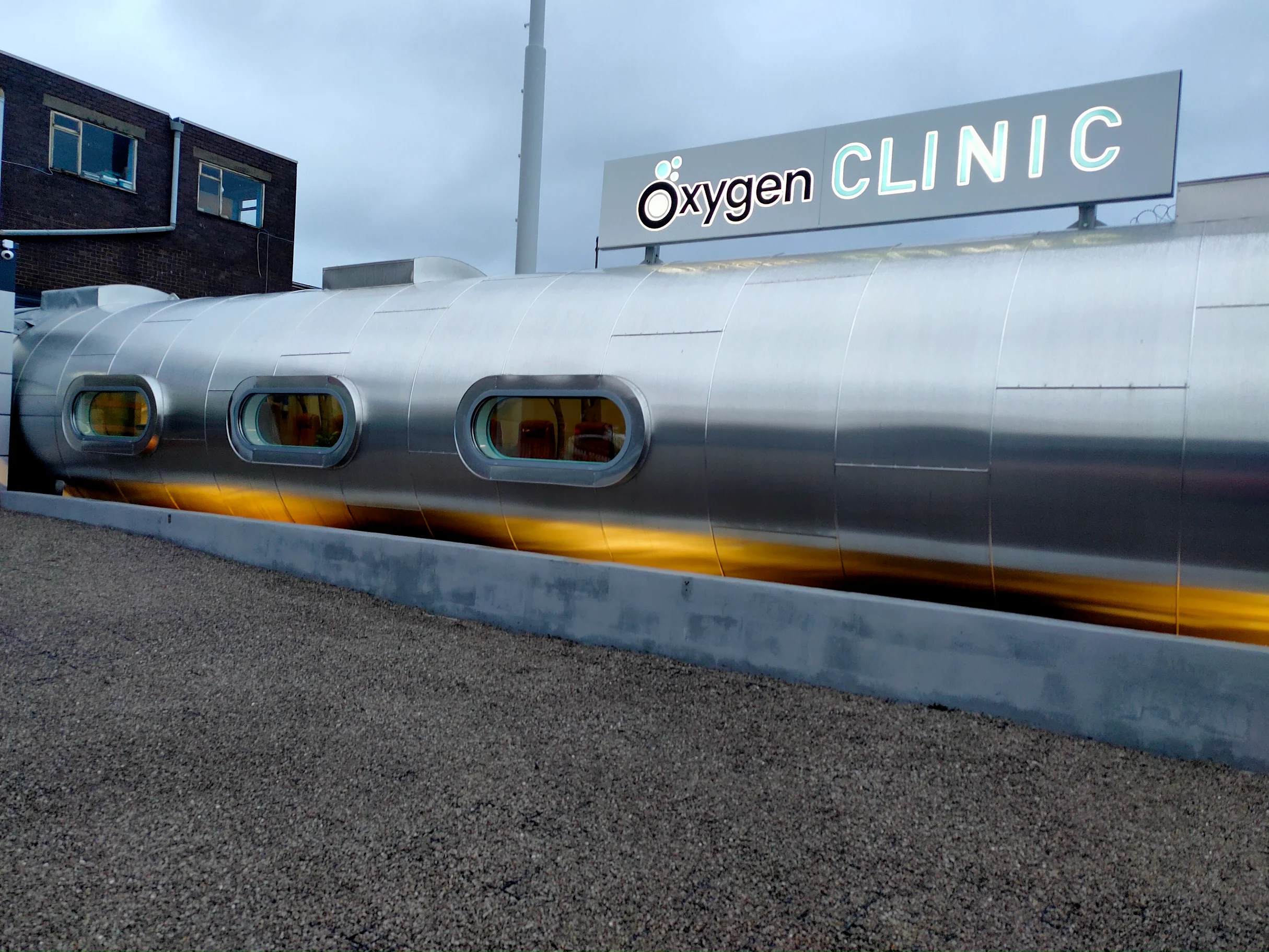
Molecular hydrogen (H₂) is a very small gas molecule made from two hydrogen atoms. Oxygen Clinic currently publishes a chamber hydrogen concentration of 0.4–0.5%, alongside approximately 32–40% oxygen and a total chamber pressure of 1500 hPa. Most experimental human H₂-inhalation studies use different concentrations and delivery methods, so their results cannot simply be transferred to an Oxygen Clinic session.
What is molecular hydrogen?
Molecular hydrogen is written as H₂. It is colourless, odourless and extremely small. In research settings it can be delivered in several ways, including inhaled gas and hydrogen-rich water.
Modern hydrogen research investigates possible effects on redox signalling, inflammation and cell-stress pathways. Those mechanisms remain an active research field; they should not be converted into a blanket claim that inhaling hydrogen treats disease.
What does 0.4–0.5% hydrogen mean inside the chamber?
The percentage describes the proportion of H₂ in the chamber gas mixture. Oxygen Clinic currently publishes:
Because the total pressure is above ordinary atmospheric pressure, gas exposure is better understood using both concentration and pressure — not concentration alone.

Why does chamber pressure change the gas exposure?
A gas’s partial pressure is approximately its fractional concentration multiplied by total pressure. As a simple illustration, 0.44% H₂ at 1500 hPa corresponds to a hydrogen partial pressure of about 6.6 hPa.
This does not tell us a clinical dose on its own. Actual exposure also depends on time, breathing, gas distribution and the biological endpoint being studied. It does, however, show why comparing “0.44% in one chamber” with “2% from another delivery system” without considering pressure and protocol can be misleading.
Has a chamber with approximately these conditions been studied?
Yes — but only preliminarily. A 2020 study examined 17 healthy adults who completed ten two-hour sessions in an Ekonstal chamber at 1500 hPa with approximately 37% oxygen, 1.079% carbon dioxide and 0.44% hydrogen.
| Study detail | What was reported | Why caution is needed |
|---|---|---|
| Participants | 17 healthy volunteers | Very small study |
| Exposure | 10 × two-hour sessions | No long-term follow-up |
| Atmosphere | 1500 hPa; ~37% O₂; 1.079% CO₂; 0.44% H₂ | Several variables changed together |
| Findings | Changes in some cognitive tests, fatigue scores and biochemical markers | Cannot identify hydrogen as the cause |
| Control group | None | Placebo, practice and time effects cannot be excluded |
The authors themselves described the study as preliminary and highlighted the small sample, lack of a control group, possible cognitive practice effects and absence of follow-up.
No — not from that chamber study
The 2020 experiment changed pressure, oxygen, carbon dioxide and hydrogen at the same time. If a measured outcome changed after ten sessions, the design could not tell whether it was caused by H₂, oxygen, pressure, CO₂, their interaction, repetition of the tests or another factor.
This is the single most important limitation when using that paper to discuss Oxygen Clinic. It is evidence that a similar combined chamber environment has been studied — not proof that 0.44% hydrogen independently produces the reported changes.

Most inhalation studies use different H₂ concentrations
A small 2021 safety study exposed eight healthy adults to 2.4% H₂ in medical air through a high-flow nasal cannula for 24–72 hours. No clinically significant adverse events were observed in that small cohort.
Reviews of hydrogen-inhalation research frequently discuss experimental concentrations around 1–4%. A 2026 respiratory-physiology modelling paper argued that the fraction of inspired hydrogen (FiH₂), rather than generator flow rate alone, is the more meaningful dosing variable.
Why does hydrogen concentration matter for engineering safety?
Hydrogen is flammable, which is why concentration, gas handling, ventilation, monitoring and ignition control matter. Scientific reviews commonly reference approximately 4% H₂ in air as the lower end of the flammable range.
Oxygen Clinic publishes an H₂ level of 0.4–0.5%. We do not use that single number as an independent safety certification: the chamber also contains elevated oxygen, and overall safety depends on the engineered system and operating controls.
Are chamber H₂ and Redox water the same exposure?
No. In the chamber, H₂ is present in the inhaled atmosphere. In hydrogen-rich water, H₂ is dissolved in a liquid and swallowed. The absorption profile, dose and timing differ.
That is why research on hydrogen-rich water should not be used as direct proof of an inhaled-hydrogen effect, and vice versa.
Read the Redox & hydrogen-rich water research guide →What can we reasonably say today?
Molecular hydrogen is a real research field with human studies using inhaled H₂ and hydrogen-rich water.
A preliminary study used a chamber atmosphere very similar to Oxygen Clinic’s published pressure and gas mixture.
That 0.4–0.5% H₂ alone caused the chamber-study findings.
That Oxygen Clinic’s H₂ concentration treats or prevents any disease.
The optimal concentration, duration and clinical relevance of H₂ across different populations.
Molecular hydrogen in oxygen chambers: quick answers
What is molecular hydrogen?
Molecular hydrogen is H₂, a gas molecule made from two hydrogen atoms. It is studied in research through inhalation, hydrogen-rich water and other delivery methods.
How much hydrogen is in the Oxygen Clinic chamber?
Oxygen Clinic currently publishes a chamber H₂ concentration of approximately 0.4–0.5%.
Has 0.44% hydrogen in a 1500 hPa chamber been studied?
A 2020 preliminary study used 0.44% H₂ together with approximately 37% oxygen, 1.079% carbon dioxide and 1500 hPa pressure. Because all of those variables were combined, the study cannot isolate the effect of hydrogen.
Is Oxygen Clinic providing hydrogen therapy?
Oxygen Clinic describes its sessions as a wellness experience, not medical treatment. The chamber’s published atmosphere includes hydrogen, but that should not be equated with a prescribed medical hydrogen-inhalation protocol.
Is hydrogen gas safe to inhale?
Small human studies have examined inhaled H₂ at concentrations such as 2.4% without clinically significant adverse events in those participants, but safety depends on concentration, delivery system, engineering controls and the individual.
Is inhaled hydrogen the same as hydrogen-rich water?
No. One is inhaled as part of a gas mixture; the other is dissolved in water and swallowed. Research from one route should not automatically be transferred to the other.
Selected sources used for this article
Want to understand the whole chamber atmosphere?
Read our technical guide to pressure, oxygen, carbon dioxide and hydrogen — or contact the team before your first session.