
What Does 1500 hPa Feel Like? Pressure, Ear Popping & the “About 5 Metres Underwater” Comparison
Most of your body does not feel “squeezed”. Your ears are where the pressure change is usually most noticeable.
Oxygen Clinic publishes a chamber pressure of approximately 1500 hPa. That is about 1.48 times standard sea-level atmospheric pressure and, as a pressure-only comparison, roughly equivalent to being about five metres below the sea surface.
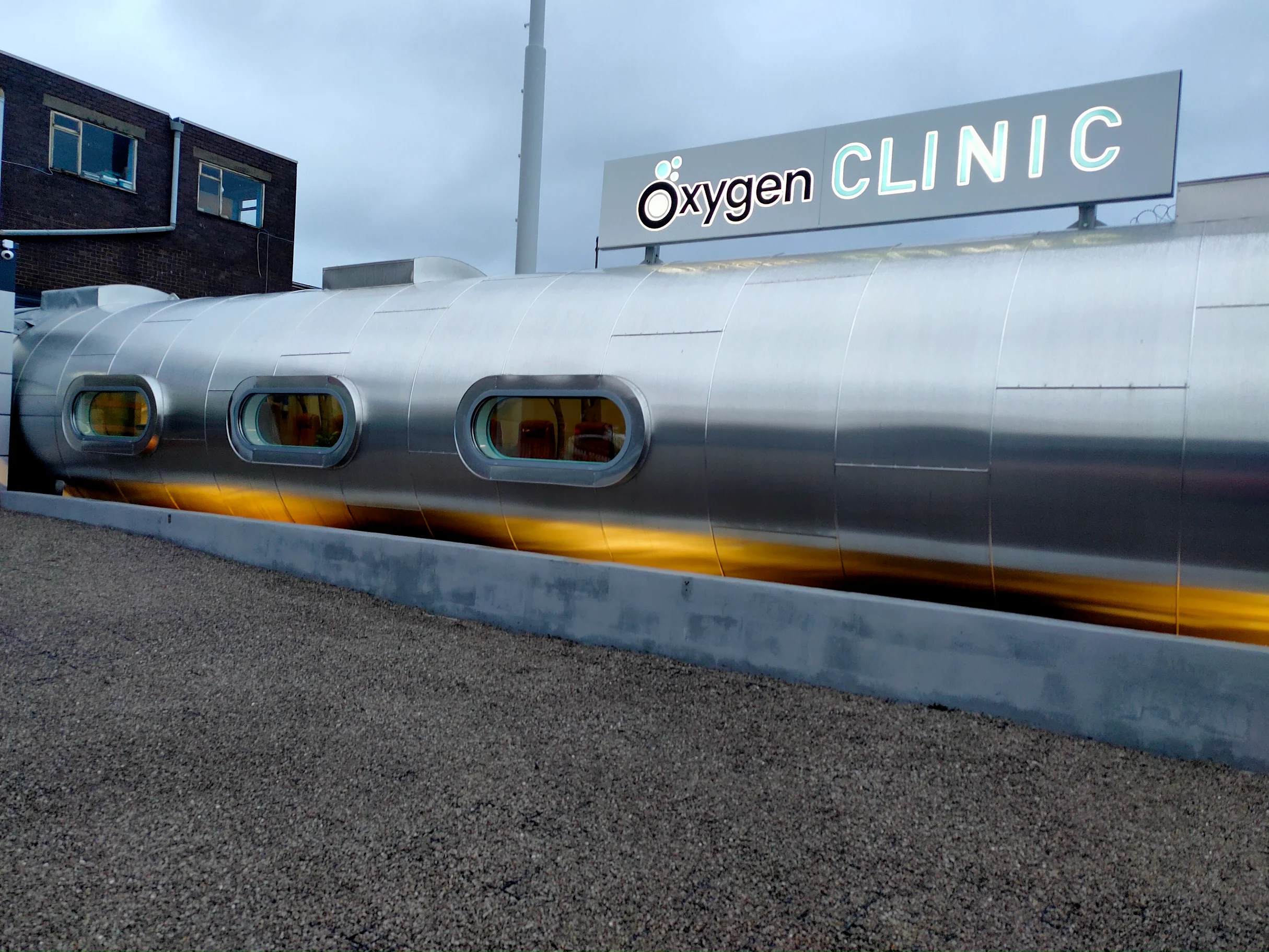
At 1500 hPa absolute pressure, most people mainly notice the pressure change in gas-filled spaces such as the middle ears. The sensation can resemble the ear pressure you notice during aircraft descent or shallow diving. Once the middle ears equalise with the chamber, the pressure itself becomes much less noticeable.
About 1.48 atmospheres absolute
Standard sea-level atmospheric pressure is approximately 1013 hPa. Dividing 1500 hPa by 1013 hPa gives about 1.48 atmospheres absolute (ATA).
The chamber therefore adds roughly 0.48 atmospheres of pressure above the pressure you would experience near sea level.
Is 1500 hPa really like being five metres underwater?
As a pressure-only comparison, approximately yes. NOAA explains that seawater pressure increases by about one atmosphere for each 10 metres of depth. An extra 0.48 atmosphere therefore corresponds to roughly 4.8–5 metres of seawater.

Why do gas-filled spaces notice the change more than the rest of your body?
Under Boyle’s law, at roughly constant temperature, gas volume decreases as surrounding pressure increases. If a sealed gas space started at 1 atmosphere and was compressed to 1.48 atmospheres, its theoretical volume would fall to about 68% of its original volume before any pressure equalisation occurred.
This is an idealised sealed-gas calculation, not a statement that your ear physically shrinks by 32%.
Most body tissues contain a large amount of water and do not compress noticeably at these pressures. The practical issue is therefore pressure across gas-filled spaces such as the middle ear and sinuses.
The Eustachian tube has to equalise middle-ear pressure
The Eustachian tube connects the middle ear to the back of the nose and throat. One of its key functions is to equalise the pressure inside the middle ear with the surrounding pressure.
During chamber compression, pressure outside the eardrum rises first. Until the middle-ear pressure catches up, you may notice fullness, pressure, muffled hearing or the familiar need to “pop” your ears.
Swallowing and yawning naturally help open the Eustachian tube. Staff can explain the appropriate equalisation technique before the session. Significant pain should be reported rather than ignored or forced through.

The pressure change is usually most obvious at the beginning and end
Equalising is harder when pressure pathways are blocked
Inflammation or obstruction around the Eustachian tube or sinuses can make pressure equalisation more difficult. Research on hyperbaric and aviation/diving pressure changes consistently links Eustachian-tube dysfunction with middle-ear barotrauma.
Oxygen Clinic’s current terms list acute sinusitis and acute otitis among its contraindications and ask people with upper-respiratory infections to postpone their visit.
Do not confuse pressure equivalence with treatment equivalence
Saying “1500 hPa is roughly the pressure at five metres of seawater” does not make an Oxygen Clinic session equivalent to diving. It also does not make the chamber equivalent to clinical HBOT.
Pressure is only one parameter. Gas composition, oxygen delivery, duration, breathing equipment, medical purpose and supervision all affect what a particular exposure actually is.
A simple pressure-readiness checklist
That is Oxygen Clinic’s current first-arrival requirement.
Staff need to know if pressure equalisation may be difficult.
Learn the appropriate equalisation technique before or during compression.
Pain is not something you need to hide to complete the session.
1500 hPa chamber pressure: quick answers
How many atmospheres is 1500 hPa?
Approximately 1.48 atmospheres absolute, using standard sea-level pressure of 1013.25 hPa.
How deep underwater is 1500 hPa equivalent to?
As a pressure-only comparison, roughly 4.8–5 metres of seawater below the surface. It is not otherwise equivalent to scuba diving.
Why do my ears pop in a pressure chamber?
The surrounding pressure changes faster than pressure in the middle ear. The Eustachian tube opens to equalise the middle ear with the surrounding environment.
Does the whole body feel compressed at 1500 hPa?
Most body tissues are largely fluid and do not noticeably compress at this pressure. Gas-filled spaces such as ears and sinuses are much more sensitive to pressure changes.
Can I use the chamber with a cold?
Oxygen Clinic currently asks people with an upper-respiratory infection to postpone their visit. Acute sinusitis and acute otitis are also listed among its contraindications.
What should I do if my ears hurt during compression?
Tell staff rather than forcing through significant pain. The clinic maintains staff contact via intercom and manages chamber entry and exit.
Technical and clinical sources used for this guide
Want to know what the pressure stage feels like before you book?
The Oxygen Clinic team can explain chamber entry, pressure equalisation and what to expect from your first two-hour session.